
The Petro Field Uncovered: Oil, Corruption, and Protest
Overview
Why do some oil-rich countries experience persistent, nonviolent mobilization instead of violent conflict or political compliance? My research introduces the concepts of petroprotest and the Petro Field framework to explain how breakdowns in oil governance—particularly executive corruption and state ownership of oil companies—transform petroleum from a source of national wealth into a catalyst for collective action.
Rather than treating oil wealth as inherently stabilizing or destabilizing, my work demonstrates that corruption within National Oil Companies (NOCs) violates the public’s moral expectation that oil revenues should benefit society. This betrayal fuels contention in highly institutionalized but structurally fragile petrostates.
Theoretical Contribution: The Petro Field
Building on Strategic Action Field (SAF) theory, I conceptualize the oil sector as a Petro Field—a meso-level arena where state officials, oil companies, and local communities interact, negotiate legitimacy, and contest the distribution of oil wealth. Within this field:
- Executive corruption disrupts the existing equilibrium by eroding shared governance norms.
- Ownership structure shapes how corruption is interpreted: NOCs carry symbolic weight as guardians of public wealth, while IOCs remain relatively insulated.
- Field disruptions give rise to petroprotests, unarmed collective actions rooted in material and symbolic claims about oil.
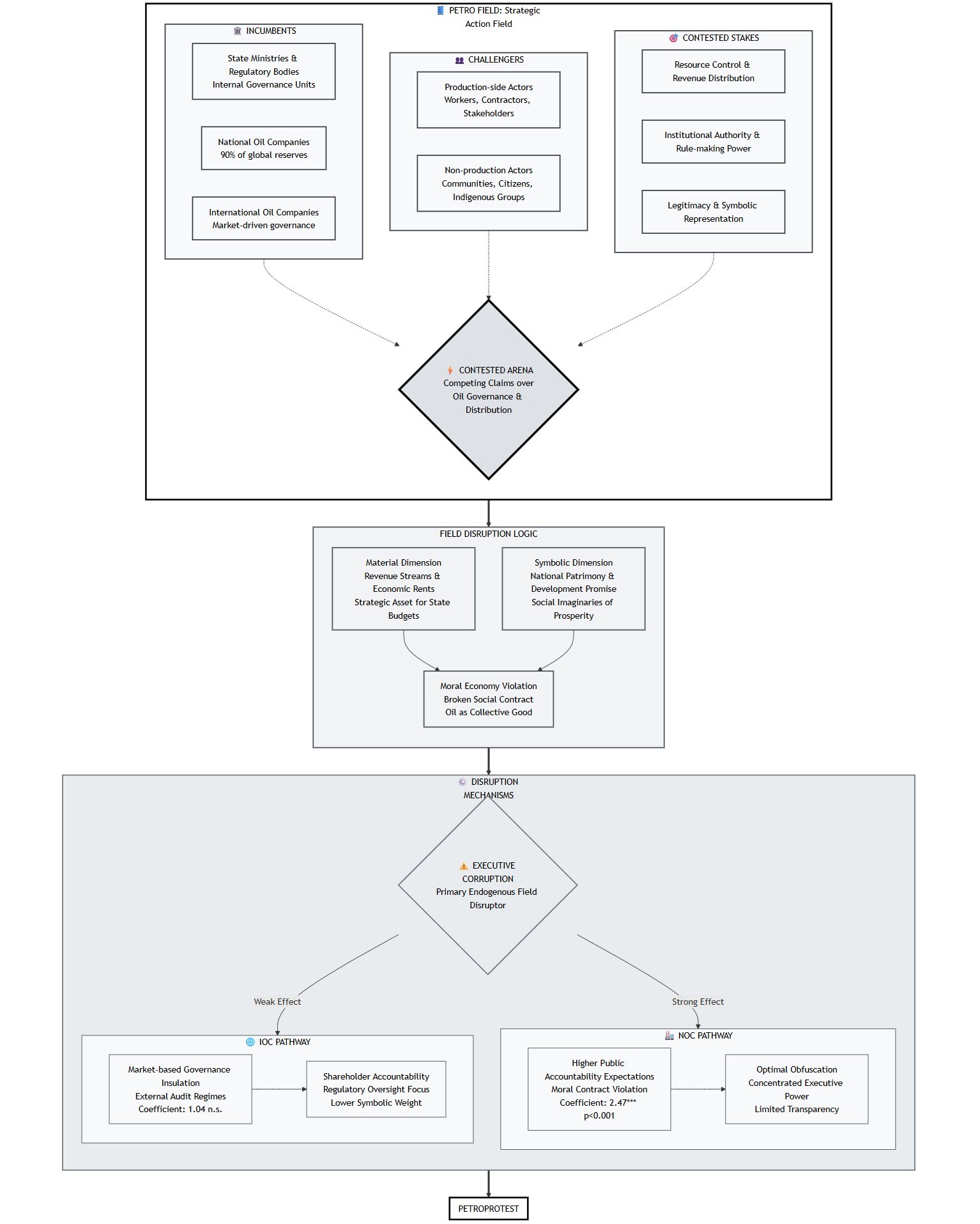
The Petro Field and the mechanisms that generate petroprotests.
Conceptual Innovation: Petroprotest
I define petroprotest as unarmed collective action explicitly linked to the governance, distribution, or symbolic meaning of oil resources. These protests:
- Emerge from perceived violations of the moral contract around oil as a national good
- Frequently target NOCs as symbols of broken public trust
- Combine material demands (jobs, infrastructure, environmental protections) with symbolic demands (justice, sovereignty, anti-corruption)
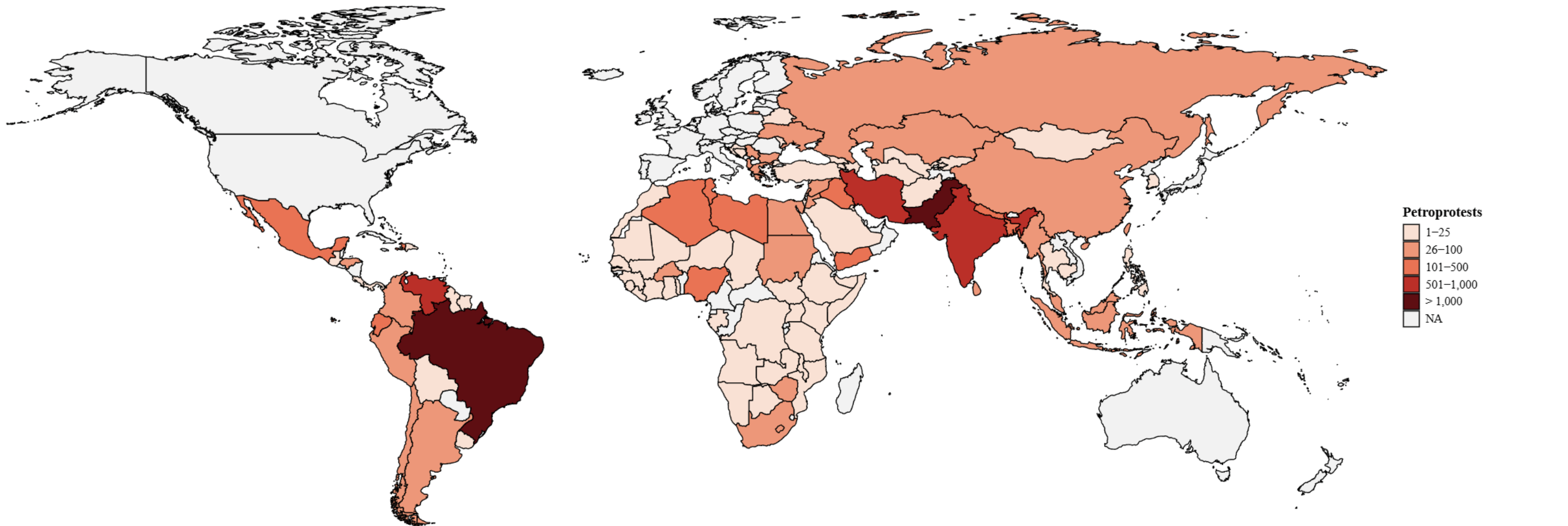
Darker shades indicate a higher frequency of petroprotests.
Multi-Scalar Empirical Design
My research employs a telescopic, multi-scalar methodology linking global patterns to local perceptions:
- Cross-National Analysis (2005–2019)
- Created the first systematic dataset of 8,200+ petroprotests
- Negative binomial models show oil infrastructure predicts protest only in high-corruption contexts, with the strongest effects in NOC-dominated sectors
- Subnational Spatial Analysis
- 50×50 km grid-cell models reveal petroprotests cluster near oil infrastructure, especially where executive corruption is high
- Protests peak at moderate distances from facilities, reflecting a “peripheral mobilization” dynamic
- Individual-Level Evidence: Original Iraq Survey
- Online survey across 90 districts (N = 797)
- Protest participation is strongly correlated with perceptions that executives divert oil revenues and with distrust in NOCs
Key Findings
- Executive corruption transforms oil from a source of prosperity into a symbol of dispossession.
- National Oil Companies (NOCs) act as focal points for public anger when they are perceived to violate the social contract.
- Petroprotests are highly spatialized, morally charged, and often persistently nonviolent.
- Governance structures—not just resource endowments—determine whether oil triggers stability or mobilization.
Active Research: The Iraqi Petro Field
My ongoing fieldwork in Iraq explores:
- Local perceptions of corruption and trust in NOCs vs. IOCs
- Protest participation patterns in high-extraction zones
- Community-company relations and infrastructure access
- Environmental and health consequences of oil operations
This micro-level evidence complements the global and subnational analyses, bridging structural dynamics with lived experiences.
Survey and Oil Infrastructure Map
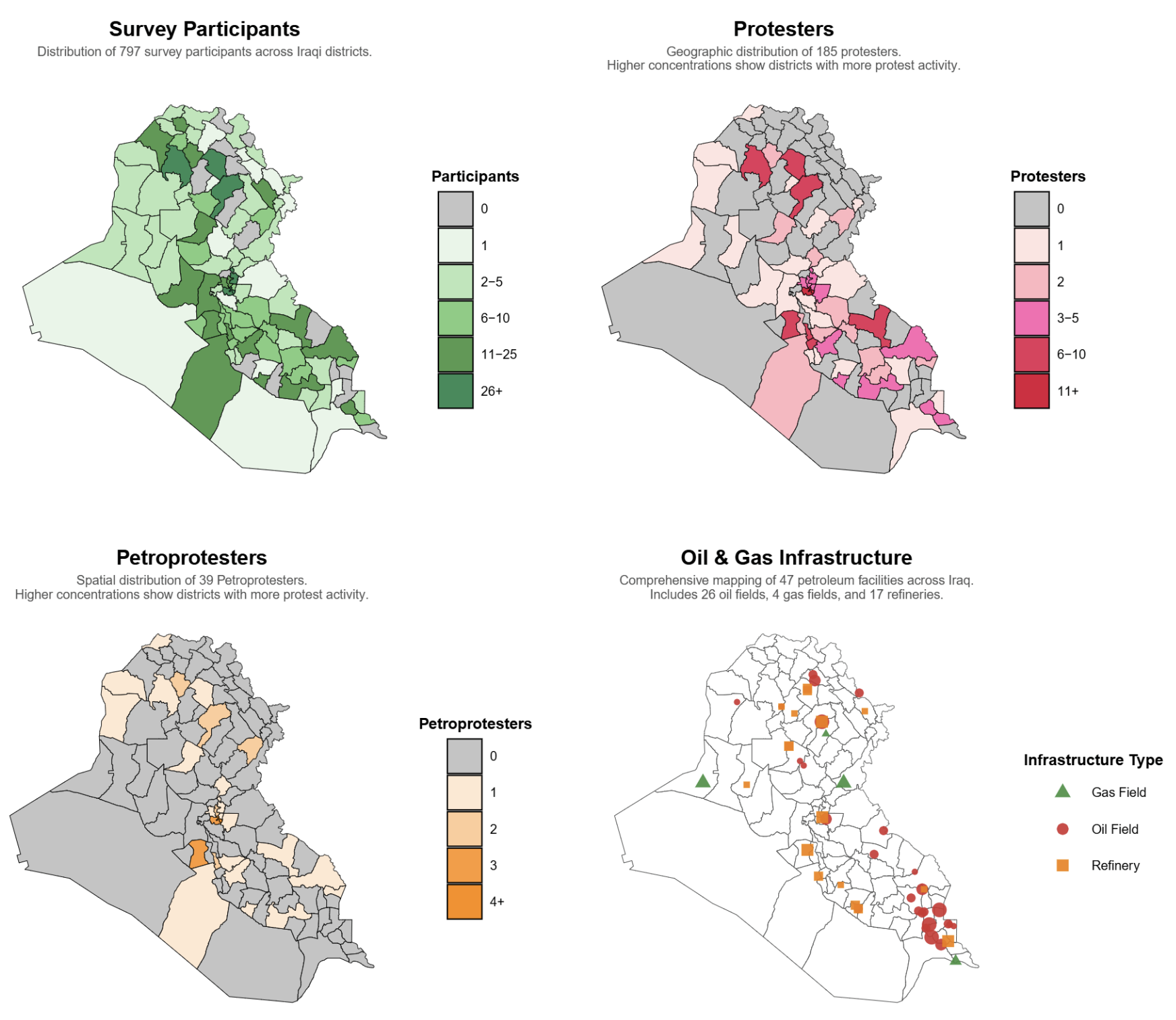
Geographic distribution of survey districts and major oil infrastructure in Iraq.
Contributions
- Theoretical – Defines the Petro Field and petroprotest, advancing meso-level theories of resource politics.
- Empirical – Produces the first cross-national petroprotest dataset and a subnational mapping of oil-related contention.
- Methodological – Implements a telescopic, multi-level design linking macro patterns to micro-level claim-making.
- Policy-Relevant – Offers insights for mitigating unrest through transparency, institutional reform, and public accountability.